CLO Tranches Explained for Beginners (Complete Guide)
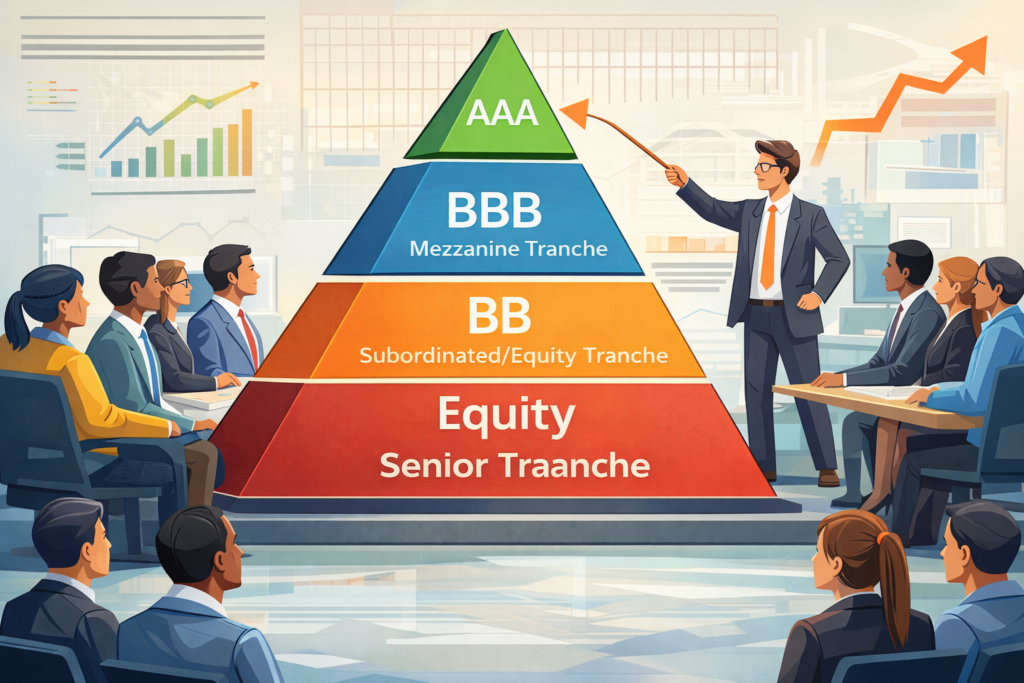
Most finance professionals struggle with CLO tranches—
Not because it’s complex…
but because it’s poorly explained.
If you’re preparing for structured finance interviews, this is one concept that can make or break your interview.
Most CFA candidates don’t understand this clearly. Even professionals working in trustee or reporting teams often work with tranches daily—but don’t fully grasp how they fit together.
Let’s fix that.
What Are CLO Tranches? (Simple Explanation)
Let’s start from scratch. [understand CLO structures and associated concepts here…]
A CLO (Collateralized Loan Obligation) is a pool of loans (usually corporate loans). These loans generate cash flows—interest and principal.
Instead of giving this cash to one investor, the CLO splits it into layers called tranches.
Think of it like a multi-layer cake:
- Top layer → safest, lowest return
- Middle layer → moderate risk and return
- Bottom layer → highest risk, highest return
Each layer = a tranche
This is what we call the CLO capital stack structure.
CLO Tranche Hierarchy Explained (Core Concept)
This is where most candidates get confused.
Let’s break down the clo tranche hierarchy explained in simple terms.
Typical CLO Tranche Structure
From top (safest) to bottom (riskiest):
- AAA Tranche (Senior)
- Lowest risk
- Gets paid first
- Lowest interest rate
- AA / A Tranches
- Slightly higher risk
- Paid after AAA
- BBB / BB (Mezzanine Tranches)
- Medium risk
- Higher returns
- Equity Tranche
- Highest risk
- Gets paid last
- Potentially highest returns
Key Rule: Payment Priority (Waterfall)
Cash flows follow a strict order:
- Interest & principal collected
- Distributed from top → bottom
This is called the waterfall
👉 Senior tranches get paid first
👉 Equity gets whatever is left
How CLO Capital Stack Structure Works (Step-by-Step)
Let’s simplify the process:
Step 1: Pool Creation
A CLO manager buys loans worth, say, $500 million.
Step 2: Issuing Tranches
The CLO issues different tranches:
- $300M AAA
- $100M AA/A
- $70M BBB/BB
- $30M Equity
Step 3: Investors Invest
Different investors buy different tranches based on risk appetite.
Step 4: Cash Flow Distribution
Loan interest comes in → distributed via waterfall.
Real-World Industry Context
Now let’s connect this to actual jobs.
Where You See This in Work:
1. CLO Middle Office Teams
- Track tranche balances
- Monitor payments
- Support waterfall calculations
2. Trustee Reporting Teams
- Prepare investor reports
- Show how each tranche was paid
3. Collateral Managers
- Ensure loan performance supports tranche payments
4. Compliance Teams
- Check if tranche protections (tests) are satisfied
5. Investment Banks
- Structure deals
- Decide tranche sizes and pricing
👉 In reality, you will constantly deal with tranche-level data.
Example Scenario (Practical Understanding)
Let’s make this real.
A CLO has:
- $500M loan pool
- Generates $25M annual interest
Tranche Structure:
- AAA → $300M (5% interest)
- AA/A → $100M (7%)
- BBB → $70M (10%)
- Equity → $30M (residual)
What Happens?
- AAA gets paid first
- Then AA/A
- Then BBB
- Equity gets remaining cash
If defaults increase:
- Equity suffers first
- Then BBB
- Senior tranches are protected
👉 This is the essence of risk distribution
Where This Appears in Real Workflows
If you’re working in structured finance, you’ll see this everywhere:
1. Trustee Reports
- Tranche balances
- Interest payments
- Principal payments
2. Monthly Investor Reports
- Performance by tranche
- Coverage ratios
3. Compliance Tests
4. Waterfall Calculations
- Payment sequencing
- Priority of payments
5. Surveillance
- Monitoring tranche risk
Common Mistakes Beginners Make
This is where most candidates get confused:
❌ Mistake 1: Thinking All Tranches Are Equal
Each tranche has a different risk-return profile.
❌ Mistake 2: Ignoring Waterfall Logic
Payments are strictly ordered.
❌ Mistake 3: Confusing Debt vs Equity
Equity is not a bond—it’s residual cash flow.
❌ Mistake 4: Not Understanding Protection
Senior tranches are protected by subordinated tranches.
❌ Mistake 5: Memorizing Instead of Understanding
Interviews test logic, not definitions.
Why This Concept Matters in CLO Jobs
If you’re targeting roles in:
- Deloitte / EY structured finance teams
- Investment banks
- Trustees
- CLO administrators
👉 You WILL be tested on this.
Because:
- Every report is tranche-based
- Every model uses tranche logic
- Every deal revolves around capital structure
Why Analysts Must Understand This Concept
This is not optional knowledge.
It helps you:
✔ Crack Interviews
Interviewers love asking:
“Explain CLO tranche structure”
✔ Perform Daily Tasks
- Reporting
- Waterfall checks
- Investor queries
✔ Understand Risk
You’ll know how losses flow through a deal.
✔ Grow Faster
This is foundational knowledge for promotions.
Quick Summary
- CLO tranches are layers of risk in a CLO
- Senior tranches = safer, lower returns
- Equity tranche = highest risk, highest return
- Cash flows follow a strict waterfall
- Losses hit equity first, then move upward
- Understanding tranche hierarchy is critical for jobs
FAQ Section (SEO Boost)
1. What are CLO tranches?
CLO tranches are different layers of a CLO that have varying risk and return levels.
2. Why is CLO tranche hierarchy important?
It determines who gets paid first and who absorbs losses.
3. How does CLO capital stack structure work?
It splits a loan pool into different risk layers from senior to equity.
4. Which tranche is safest in a CLO?
AAA tranche is the safest as it gets paid first.
5. Why do investors choose different tranches?
Based on their risk appetite and return expectations.
Conclusion
Understanding clo tranches explained for beginners is one of the most important building blocks in structured finance.
Once you understand this:
- Waterfalls become easier
- Reports make sense
- Interviews become simpler
If you’re serious about building a career in structured finance, master this concept.
And if this finally made things clear—
You’re exactly the kind of learner SFA is built for.
Suggested Readings: