CLO Structure Explained For Beginners
Many professionals working in structured finance hear terms like “tranches,” “waterfall,” and “overcollateralization” every day — but very few truly understand how the entire CLO structure actually works.
And this is where most beginners struggle.
If you’re preparing for a role in Deloitte, EY, a bank, or a CLO administrator team, understanding the CLO structure explained for beginners is not optional — it’s foundational.
Let’s break it down in the simplest way possible.
Simple Explanation of CLO Structure
Think of a CLO like a basket of loans.
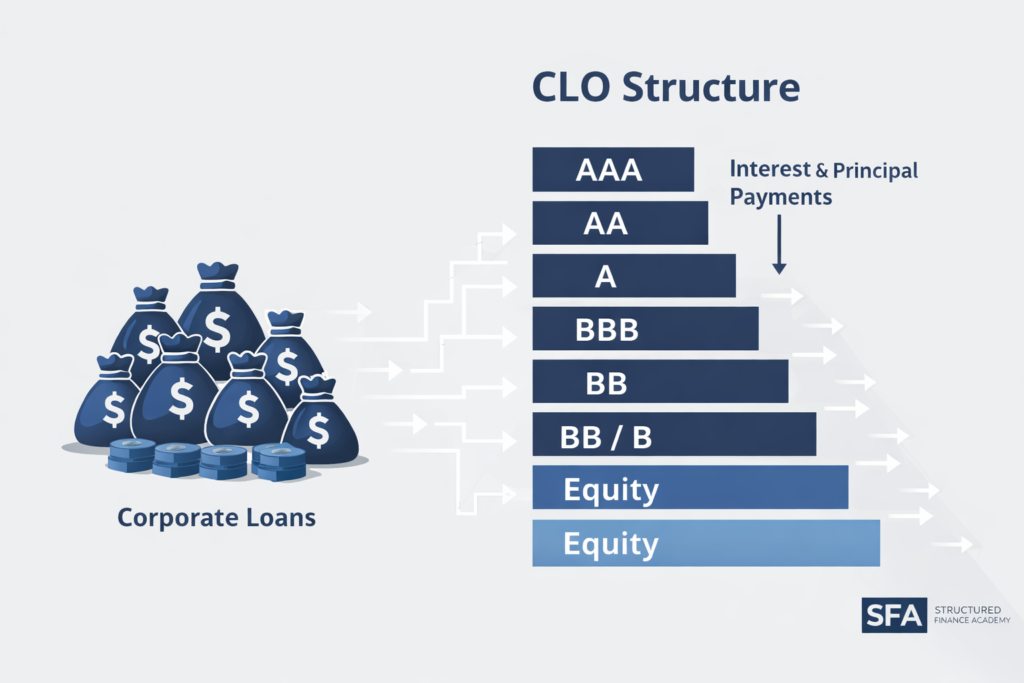
A financial institution or collateral manager collects hundreds of corporate loans and puts them into one pool. This pool is then divided into slices and sold to investors.
Each slice is called a tranche.
Here’s the key idea:
- Safer investors get paid first but earn lower returns
- Riskier investors get paid later but earn higher returns
It’s similar to a queue:
- First in line → safest
- Last in line → riskiest
This simple idea forms the backbone of the CLO deal structure explained in practice.
Core Concept Explained: Step-by-Step CLO Structure
Let’s now break down the CLO transaction structure step-by-step.
Step 1: Creation of Loan Pool
- A collateral manager selects corporate loans (typically leveraged loans)
- These loans form the collateral pool
- Example size: $300M – $1B+
Step 2: Formation of Special Purpose Vehicle (SPV)
- A separate legal entity (SPV) is created
- The SPV purchases the loans
- This isolates risk from the parent entity
Step 3: Issuance of Tranches (Capital Structure)
The SPV issues different layers of securities:
| Tranche | Risk Level | Return | Priority |
|---|---|---|---|
| AAA | Lowest | Lowest | Paid first |
| AA | Low | Low | After AAA |
| A | Medium | Medium | After AA |
| BBB | Higher | Higher | After A |
| BB / B | High | Very High | After BBB |
| Equity | Highest | Residual | Paid last |
This layered structure is called the CLO capital structure.
Step 4: Cash Flow Waterfall
All interest and principal from loans flow into the CLO and are distributed in a strict order:
- Trustee & admin fees
- Senior (AAA) investors
- Mezzanine investors
- Junior tranches
- Equity investors
This is known as the waterfall mechanism.
Step 5: Credit Protection Mechanisms
To protect investors, CLOs use:
- Overcollateralization (OC) tests
- Interest Coverage (IC) tests
- Diversification rules
- Rating constraints
These ensure the structure remains stable.
Real-World Industry Context
Now let’s connect this to real jobs.
In actual structured finance roles:
CLO Middle Office Teams
- Track loan trades
- Monitor collateral quality
- Update portfolio metrics
Trustee Reporting Teams
- Prepare monthly reports
- Calculate interest distributions
- Validate waterfall outputs
Collateral Managers
- Buy/sell loans
- Optimize portfolio returns
- Ensure compliance with CLO rules
Analysts in Deloitte / EY / Banks
- Perform compliance testing (OC/IC)
- Validate cash flows
- Support deal modeling
This is where the clo structure explained for beginners becomes real — not theoretical.
Example / Scenario
Let’s simplify with a practical example.
A CLO has:
- $500 million of corporate loans
- Generates ~8% annual interest = $40 million
Now this $40 million is distributed:
- $5M → Fees (trustee, admin, manager)
- $15M → AAA investors
- $8M → AA/A investors
- $5M → BBB investors
- $2M → BB/B investors
- Remaining $5M → Equity investors
If defaults increase:
- Lower tranches (BB, Equity) absorb losses first (First Loss Class)
- Senior tranches remain protected
This is the real essence of CLO tranche structure.
Where This Appears in Real Workflows
You will see this structure in:
1. Trustee Reports
- Monthly cash flow distribution
- Outstanding tranche balances
- OC/IC test results
2. Investor Reports
- Performance summary
- Default and recovery tracking
3. Compliance Testing
- OC ratio calculations
- IC ratio calculations
4. Waterfall Models (Excel / Systems)
- Step-by-step cash allocation
- Scenario analysis
5. Collateral Monitoring Tools
- Portfolio quality tracking
- Concentration limits
Understanding the clo diagram explanation helps you read these reports faster.
Common Mistakes or Misunderstandings
Beginners often make these mistakes:
- Thinking CLO is just a loan pool (it’s a structured product)
- Ignoring the importance of tranches
- Confusing waterfall with simple interest distribution
- Not understanding OC/IC triggers
- Assuming equity is “safe” because of high returns
Avoid these, and you’re already ahead of 80% of candidates.
Why This Concept Matters in CLO Jobs
If you’re working or planning to work in:
- Deloitte / EY structured finance teams
- Investment banks
- CLO administrators
- Trustee firms
You will constantly deal with:
- Tranche-level calculations
- Waterfall validations
- Compliance testing
- Investor reporting
Without understanding the clo capital structure, your work will feel mechanical.
With understanding — it becomes strategic.
Career Insight: Why Analysts Must Understand This Concept
This is not just theory.
Knowing the clo structure explained for beginners helps you:
- Crack interviews (very common question)
- Understand deal documents faster
- Perform better in reporting roles
- Transition to higher-paying front-office roles
- Build credibility in structured finance
Senior analysts are not those who run models — they are those who understand the structure behind the model.
Quick Summary
- CLO = pool of corporate loans structured into tranches
- SPV issues securities to investors
- Cash flows follow a strict waterfall
- Senior tranches = safer, lower return
- Equity = riskiest, highest return
- OC/IC tests protect investors
- Widely used in structured finance roles
FAQ Section (SEO Boost)
1. What is a CLO in simple terms?
A CLO is a pool of corporate loans divided into tranches and sold to investors based on risk and return.
2. What is CLO tranche structure?
It refers to different layers (AAA to Equity) with varying risk levels and payment priority.
3. How does CLO waterfall work?
Cash flows are distributed in a fixed order — from senior investors to equity holders.
4. Why is CLO capital structure important?
It determines risk distribution and protects senior investors from losses.
5. Where is CLO structure used in real jobs?
In trustee reporting, compliance testing, collateral management, and investor reporting.
Conclusion
Understanding the clo structure explained for beginners is your first real step into structured finance.
Once you grasp this, everything else — waterfalls, compliance tests, reporting — starts making sense.
If you want to build a strong career in CLOs, don’t just memorize concepts — understand how the structure works in real life.
That’s exactly what separates an average analyst from a high-impact professional.