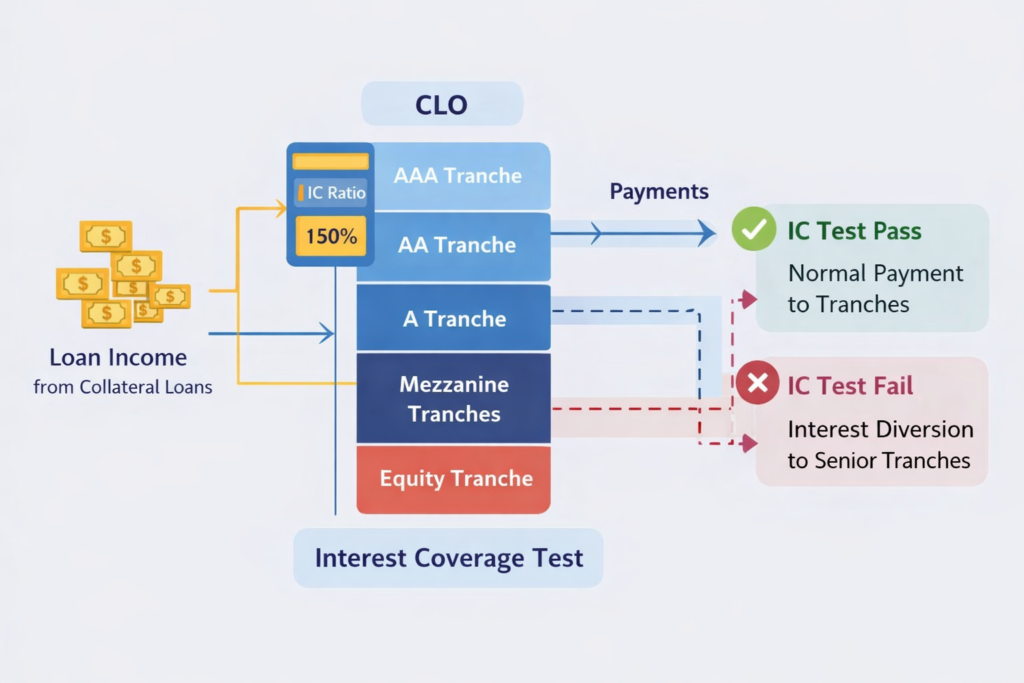
Interest Coverage Test in CLO: A Simple Guide for Professionals
Many professionals working in structured finance deal with CLO waterfalls, reports, and compliance tests daily — yet one concept that often remains unclear is the Interest Coverage Test in CLO.
You may have seen it in trustee reports or compliance sections, but if someone asked you:
“What exactly triggers it, and what happens when it fails?”
Most people hesitate.
And this is exactly where clarity gives you an edge in interviews and real jobs.
What is Interest Coverage Test in CLO
Think of a CLO like a business that earns income (interest from loans) and has to pay expenses (interest to investors).
The Interest Coverage Test in CLO checks:
👉 “Is the income from the loan portfolio enough to pay interest to investors?”
If yes → everything runs smoothly
If no → the deal activates protection mechanisms
Simple Analogy
Imagine:
- You earn ₹1,00,000 per month
- Your EMI obligations = ₹80,000
You’re safe.
But if your income drops to ₹60,000?
You can’t meet obligations → corrective action needed
That’s exactly what the IC test does in a CLO
IC Ratio in CLO Explained
At its core, the test is a ratio:
Interest Coverage Ratio = Interest Income / Interest Payable
The CLO checks this ratio for different tranches.
How It Works Step-by-Step
- Calculate Interest Income
- From underlying loans in the portfolio
- Calculate Interest Due
- For each tranche (AAA, AA, etc.)
- Compute IC Ratio
- Income ÷ Interest obligation
- Compare with Threshold
- Each tranche has a minimum required level
- Determine Pass/Fail
- Above threshold → Pass
- Below threshold → Fail
Example Thresholds
| Tranche | IC Ratio Requirement |
|---|---|
| AAA | 120% – 130% |
| AA | 110% – 120% |
| Mezz | Lower thresholds |
Overcollateralization vs Interest Coverage Test
This is one of the most important distinctions beginners miss.
| Feature | IC Test | OC Test |
|---|---|---|
| Focus | Cash flow (income) | Asset value |
| Measures | Ability to pay interest | Asset backing |
| Trigger type | Income-based stress | Default/valuation stress |
IC Test = Cash flow protection
OC Test = Capital protection
Both work together to protect investors.
Real-World Industry Context
In real structured finance jobs, the Interest Coverage Test in CLO appears everywhere.
Where Analysts Work with IC Test
CLO Middle Office Teams
- Monitor IC ratios monthly
- Flag breaches
- Coordinate with portfolio managers
Trustee Reporting Teams
- Calculate IC ratios
- Include in investor reports
- Validate compliance
Collateral Managers
- Track portfolio income
- Adjust strategy if IC weakens
Investment Banks / Consulting Firms
- Build IC test logic in models
- Perform deal analysis
In reality, this is not just theory — it is part of your daily workflow.
Example: Interest Coverage Test in Action
Let’s simplify with a practical scenario:
CLO Structure
- Loan Portfolio: $500 million
- Average interest income: $30 million/year
Investor Obligations
- AAA interest: $15 million
- AA interest: $8 million
IC Ratio Calculation
For AAA:
IC Ratio = 30 / 15 = 2.0 (200%)
Pass (well above threshold)
Now assume income drops to $18 million:
IC Ratio = 18 / 15 = 1.2 (120%)
Close to threshold → risk zone
If income falls further:
IC Ratio = 14 / 15 = 0.93 (93%)
Fail
What Happens When IC Test Fails?
This is where things get interesting.
CLO activates interest diversion mechanism
Instead of paying lower tranches:
- Cash is redirected to senior tranches
- Junior investors may not receive payments
Where This Appears in Real Workflows
You will encounter IC Test in:
- Trustee reports (monthly/quarterly)
- Investor reporting packages
- Compliance test sections
- Waterfall calculations
- Surveillance dashboards
- Deal monitoring systems
In many roles, your job is:
- Validate IC ratios
- Investigate breaches
- Communicate impact
Common Mistakes or Misunderstandings
Many beginners get confused here:
Thinking IC Test = OC Test
Assuming it measures asset quality (it doesn’t)
Ignoring its link to waterfall
Not understanding trigger consequences
Believing failure means deal collapse (it doesn’t)
Reality:
It is a protective mechanism, not a failure of the deal itself
Why This Concept Matters in CLO Jobs
If you’re working or aspiring to work in:
- Deloitte / EY structured finance teams
- Investment banks
- CLO administrators
- Trustees
- Collateral managers
You WILL encounter this concept regularly.
Practical Importance
- Helps you understand deal health
- Critical for compliance reporting
- Essential for waterfall logic
- Important in investor communication
Knowing this clearly sets you apart from 80% of candidates.
Career Insight: Why Analysts Must Understand This
Understanding the Interest Coverage Test in CLO helps you:
In Interviews
- Answer scenario-based questions
- Explain triggers confidently
In Day-to-Day Work
- Interpret reports better
- Detect issues early
For Career Growth
- Move from execution → understanding
- Gain trust in teams
This is the difference between a data processor and a finance professional
Quick Summary
- IC Test checks if income can cover interest payments
- It is a cash flow-based protection mechanism
- Failure leads to interest diversion
- Used in reporting, compliance, and waterfall
- Critical for structured finance roles
FAQ: Interest Coverage Test in CLO
1. What is Interest Coverage Test in CLO?
It measures whether CLO income is sufficient to pay interest to investors.
2. Why is IC Test important?
It protects senior investors by ensuring they are paid first.
3. What happens when IC test fails?
Cash is diverted from junior tranches to senior tranches.
4. How is IC Ratio calculated?
Interest income divided by interest payable.
5. Is IC Test same as OC Test?
No. IC focuses on income, OC focuses on asset value.
Conclusion
The Interest Coverage Test in CLO is not just a theoretical concept — it is a core mechanism that drives cash flow protection, investor safety, and deal stability.
Once you understand it clearly, you will:
✔ Read CLO reports with confidence
✔ Understand waterfall logic deeply
✔ Perform better in interviews and real roles
If you want to master structured finance, this is one of the foundational concepts you must get right.
Explore more such simplified guides on Structured Finance Academy (SFA) and build real expertise.
Suggested Next Articles
What is a CLO?
CLO Waterfall Explained
Overcollateralization Test in CLO Deals Explained