Most candidates fail to explain this in interviews — but it’s actually simple.
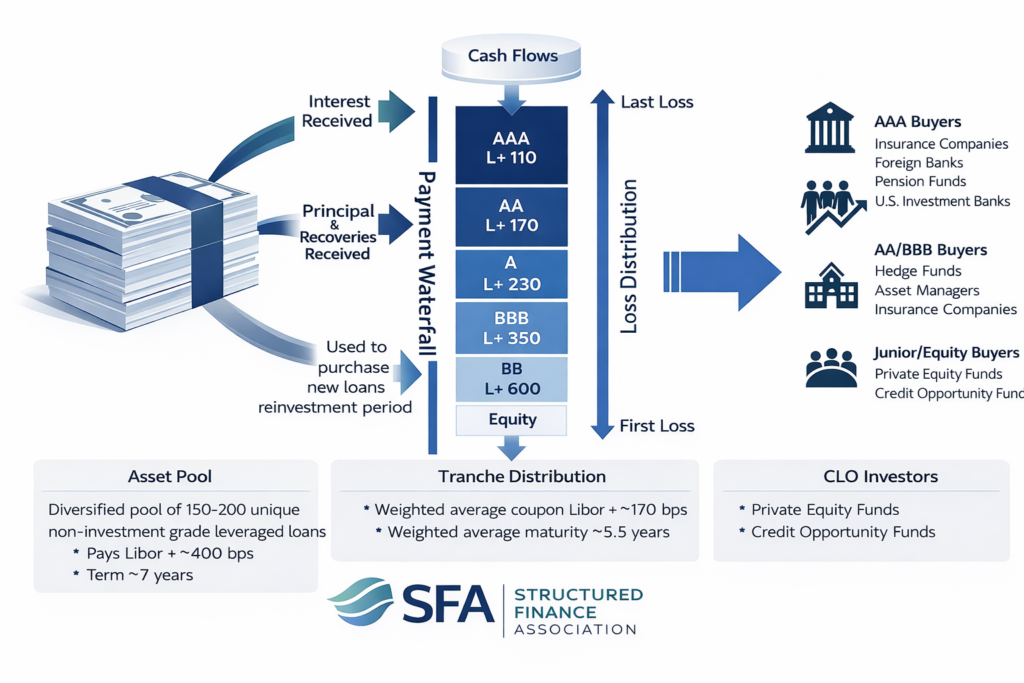
Most people hear the term “waterfall” in finance…
But what does it actually mean?
A waterfall simply refers to how cash or payments are distributed in a specific order.
This concept is used across:
- Loans
- Structured finance
- CLOs
Before we dive into CLO waterfall…In this article, we’ll break down how a CLO waterfall works in a simple, step-by-step way with a diagram and example.
Let’s quickly understand what a “waterfall” means in finance.
A waterfall simply refers to how cash or payments are distributed in a specific order.
This concept is used in:
• Loans
• Structured finance
• Securitization deals
Now, let’s see how it works specifically in a CLO.
Collateralized Loan Obligations (CLOs) can appear complex when you first encounter them. However, once you understand the CLO waterfall, the structure becomes much easier to analyze.
For analysts, especially those preparing for roles in structured finance teams, collateral management firms, trustees, and middle-office operations, understanding the waterfall is essential. In practical terms, the waterfall tells us who gets paid, in what order, and from which cash flows.
This article explains the CLO waterfall in simple language, using a realistic but simplified example inspired by common CLO indenture structures. The goal is to help analysts understand how cash moves through a CLO each payment period.
1. Waterfall payment structure explained
A CLO waterfall is the priority of payments that determines how cash generated by the CLO’s loan portfolio is distributed.
The waterfall is documented in the Indenture, which is the legal document governing the CLO transaction.
Every payment period (usually quarterly or monthly), the CLO collects:
- Interest from underlying leveraged loans
- Principal repayments or loan prepayments
- Fees and expenses
These cash flows are then distributed according to a strict priority structure.
Think of the waterfall as a series of buckets arranged from top to bottom.
- The top bucket gets filled first.
- Only after it is full does cash move to the next bucket.
2. Two Types of CLO Waterfalls
Most CLOs have two main waterfalls:
1. Interest Waterfall
Used to distribute interest income generated by the loan portfolio.
Payments typically include:
- Trustee and administrative fees
- Senior management fees
- Interest payments to CLO debt tranches
- Subordinated management fees
- Equity distributions
2. Principal Waterfall
Used to distribute principal collections such as:
- Loan repayments
- Prepayments
- Sale proceeds
Principal cash is primarily used to:
- Reinvest in new loans during the reinvestment period
- Pay down CLO notes if tests fail
- Redeem debt tranches sequentially
3. Typical CLO Capital Structure
Before understanding the waterfall, analysts should understand the CLO liability structure.
A simplified CLO might look like this:
| Tranche | Rating | Size | Coupon |
|---|---|---|---|
| Class A | AAA | $300M | SOFR + 1.50% |
| Class B | AA | $50M | SOFR + 2.20% |
| Class C | A | $30M | SOFR + 3.00% |
| Class D | BBB | $20M | SOFR + 4.50% |
| Subordinated Notes | Equity | $50M | Residual |
Total CLO Size = $450M
The CLO then invests in approximately $450M of leveraged loans.
4. Simplified Interest Waterfall
Below is a simplified example inspired by the typical payment priority seen in CLO indentures.
Step-by-Step Interest Waterfall
During each payment date, interest proceeds are generally distributed in the following order:
1. Trustee and Administrative Fees
These include payments to:
- Trustee
- Collateral administrator
- Paying agent
Example:
- Trustee fee = $50,000
2. Senior Management Fee
Paid to the collateral manager for managing the portfolio.
Example:
- 0.15% of collateral balance annually
3. Interest on Class A Notes
The most senior debt tranche.
Example:
- Class A outstanding = $300M
- Coupon = SOFR + 1.50%
If SOFR = 5%
Interest due:
$300M × 6.5% / 4 = $4.875M quarterly
4. Interest on Class B Notes
Next tranche receives payment.
Example:
- $50M outstanding
- Coupon = SOFR + 2.20%
Quarterly payment:
$50M × 7.2% / 4 = $0.90M
5. Interest on Class C Notes
Next level of risk.
6. Interest on Class D Notes
Lower-rated tranche.
7. Subordinated Management Fee
Some CLOs include additional manager compensation here.
Example:
- 0.35% annually
8. Equity Distribution
Whatever cash remains flows to equity investors.
This is why CLO equity can generate high returns if the loan portfolio performs well.
5. Simple Numerical Example
Let’s assume the CLO portfolio generates:
Total Interest Collected This Quarter = $8 million
Now distribute according to the waterfall.
Step 1 – Fees
Trustee + admin fees = $0.1M
Remaining cash:
$8M – $0.1M = $7.9M
Step 2 – Senior Management Fee
Manager fee = $0.2M
Remaining:
$7.9M – $0.2M = $7.7M
Step 3 – Class A Interest
Payment required = $4.875M
Remaining:
$7.7M – $4.875M = $2.825M
Step 4 – Class B Interest
Payment required = $0.90M
Remaining:
$2.825M – $0.90M = $1.925M
Step 5 – Class C Interest
Payment required = $0.60M
Remaining:
$1.925M – $0.60M = $1.325M
Step 6 – Class D Interest
Payment required = $0.40M
Remaining:
$1.325M – $0.40M = $0.925M
Step 7 – Subordinated Management Fee
Manager receives additional $0.15M.
Remaining:
$0.925M – $0.15M = $0.775M
Step 8 – Equity Distribution
Remaining amount distributed to equity investors.
Equity cash flow = $775,000
6. What Happens When Tests Fail?
CLO waterfalls are not static.
They can change depending on coverage tests.
Two important tests are:
Overcollateralization (OC) Test
Ensures the loan portfolio provides enough collateral relative to debt.
Example:
Required OC ratio for Class A = 120%
If the ratio falls below the threshold, the waterfall diverts cash away from equity.
Instead, the cash is used to pay down senior notes.
Interest Coverage (IC) Test
Measures whether portfolio interest income covers debt interest obligations.
Example:
Required IC ratio = 150%
If the test fails:
- Equity distributions stop
- Cash is redirected to senior note repayment
7. Principal Waterfall Explained
Principal collections include:
- Loan repayments
- Prepayments
- Loan sales
How this cash is used depends on the reinvestment period.
During Reinvestment Period
Principal proceeds are usually reinvested into new loans.
Example:
Loan repayment = $10M
Manager purchases:
- New leveraged loan
- Price = 99
Principal continues generating interest income.
After Reinvestment Period
Principal proceeds are used to pay down CLO notes sequentially.
Typical order:
- Class A redemption
- Class B redemption
- Class C redemption
- Class D redemption
- Equity receives residual
This is called sequential amortization.
8. Role of the Trustee and Collateral Manager
In practice, the waterfall is operationally executed by multiple parties.
Collateral Manager
Responsible for:
- Managing loan portfolio
- Trading loans
- Monitoring portfolio tests
Examples of global managers include large asset managers specializing in leveraged loans.
Trustee
The trustee performs several operational tasks:
- Calculates waterfall payments
- Maintains noteholder records
- Ensures compliance with indenture rules
- Distributes payments
Trustees rely heavily on cash flow models and reporting systems.
9. Why Analysts Must Understand the Waterfall
In real CLO operations, analysts frequently work with:
- Payment date reports
- Waterfall models
- Trustee reports
- Compliance tests
Typical analyst tasks include:
- Validating interest proceeds
- Reconciling tranche interest calculations
- Monitoring OC/IC tests
- Reviewing trustee payment files
- Checking portfolio cash flows
Understanding the waterfall helps analysts answer questions like:
- Why did equity receive less cash this quarter?
- Why were senior notes partially redeemed?
- Why did reinvestment stop?
10. Common Mistakes Analysts Make
When learning CLO waterfalls, analysts often misunderstand:
Mixing Interest and Principal Waterfalls
These are separate streams.
Interest usually funds debt coupons, while principal funds reinvestment or amortization.
Ignoring Coverage Tests
Coverage tests can redirect cash flows, changing expected distributions.
Misinterpreting Equity Returns
Equity returns depend on:
- Loan spreads
- Default rates
- Trading gains
- Fees
11. Key Takeaway
The CLO waterfall is the core engine of a CLO transaction.
It determines how cash generated by leveraged loans flows through the structure.
In simplified terms:
Loans generate cash → Cash enters waterfall → Payments follow strict priority
Senior investors are protected through:
- Priority payments
- Overcollateralization tests
- Interest coverage tests
Equity investors receive residual returns, but they also bear the highest risk.
For analysts working with CLOs, mastering the waterfall is critical because it connects:
- Loan portfolio performance
- Debt tranche payments
- Equity distributions
Once you understand the waterfall mechanics, the entire CLO structure becomes far easier to analyze. [know more about CLO Structures]
GENERAL WATERFALL vs CLO WATERFALL
Waterfall is a general concept in finance.
But in CLOs:
• It is more structured
• It involves multiple tranches
• It is linked to credit risk
This is why CLO waterfalls are more complex than basic loan waterfalls.
Tip for Job Aspirants
When preparing for structured finance interviews, you should be able to explain:
- CLO capital structure
- Interest vs principal waterfall
- OC and IC tests
- Reinvestment period mechanics
If you can clearly explain the waterfall with a numerical example, interviewers will know you understand CLO cash flow mechanics.
FINAL FAQ SECTION
What is a waterfall in finance?
A waterfall in finance refers to the order in which cash flows or payments are distributed among different stakeholders.
Instead of payments being made randomly, they follow a predefined priority structure, where some investors or obligations are paid before others.
This concept is widely used in:
- Loans
- Structured finance
- Securitization deals
What is a CLO waterfall?
A CLO (Collateralized Loan Obligation) waterfall is the payment structure that determines how cash generated from a pool of loans is distributed among different investors.
In a CLO:
- Payments are made in a strict sequence
- Senior debt investors are paid first
- Equity investors are paid last
This structure ensures risk is allocated properly across different tranches.
Who gets paid first in a CLO?
In a CLO waterfall, payments follow a strict hierarchy:
- Fees and expenses
- Senior (AAA) tranche investors
- Mezzanine tranche investors
- Equity investors (last)
Senior investors are paid first because they take lowest risk, while equity investors receive residual cash and bear the highest risk.
How does CLO cash flow work?
CLO cash flow comes from the interest and principal payments made by underlying loans.
This cash is then distributed through the waterfall:
→ First, operational fees are paid
→ Then, senior investors receive payments
→ Followed by mezzanine investors
→ Any remaining cash goes to equity holders
If cash flows decline, equity investors are impacted first, while senior investors remain protected.
Suggested next reading–