What Is CLO Tail Risk?
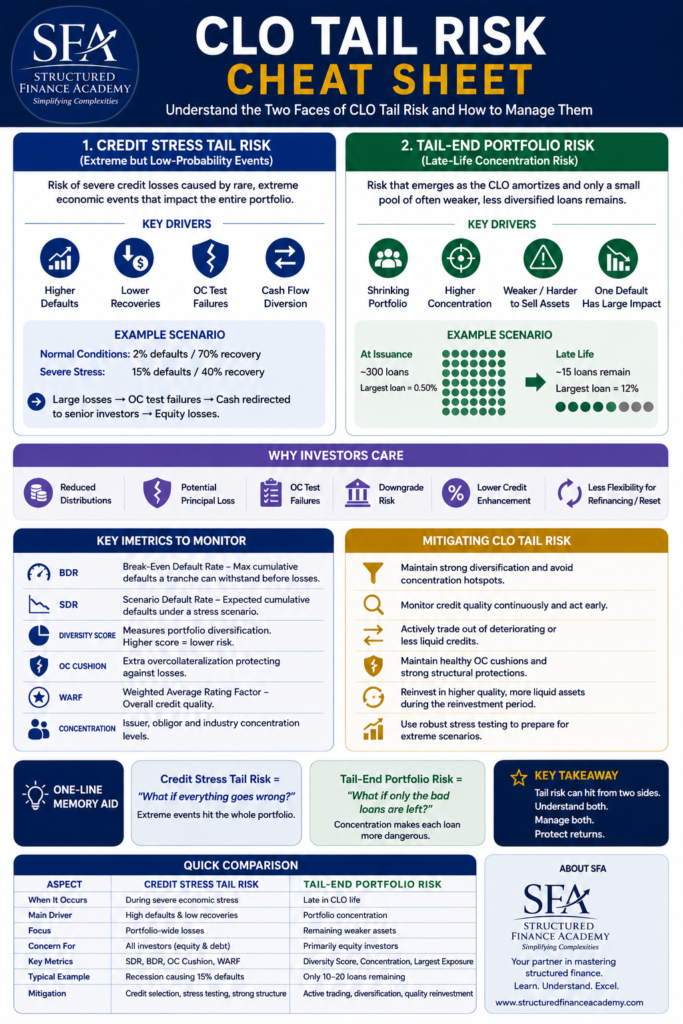
CLO Tail Risk is a term used in two different but related ways within the Collateralized Loan Obligation (CLO) market.
The first definition refers to the risk of extreme but low-probability credit events that can cause significant losses to a CLO structure. This is the perspective commonly used by rating agencies and cash flow modelers.
The second definition refers to the risk that emerges toward the end of a CLO’s life when most senior liabilities have been paid down and only a small pool of remaining loans is left in the portfolio. These remaining assets are often less diversified and may include weaker or harder-to-sell credits.
Understanding both perspectives is essential for CLO analysts, investors, portfolio managers, and students of structured finance.
The Two Faces of CLO Tail Risk
1. Credit Stress Tail Risk
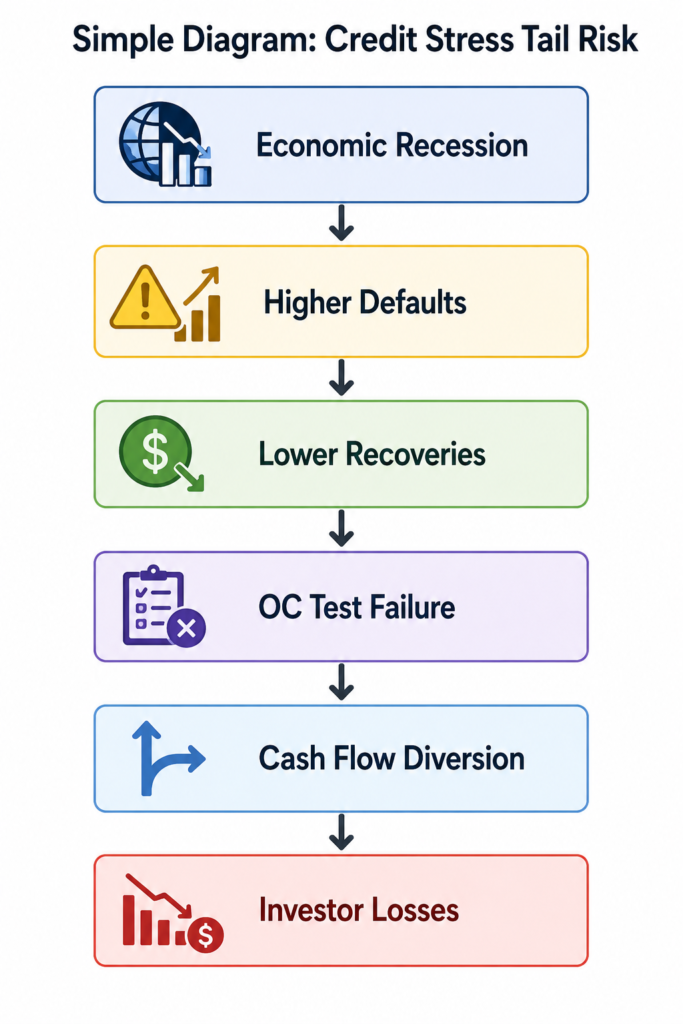
Under this definition, CLO Tail Risk represents the possibility of severe losses arising from rare but extreme economic events.
Examples include:
- Global recessions
- Credit market crises
- Industry-wide defaults
- Sharp declines in recovery rates
- Prolonged economic downturns
These events are unlikely but can significantly impact CLO performance.
Example
Assume a CLO holds 300 broadly syndicated loans.
Under normal conditions:
- Annual default rate = 2%
- Recovery rate = 70%
During a severe recession:
- Default rate rises to 15%
- Recovery rate falls to 40%
Losses increase dramatically, overcollateralization tests may fail, and cash flows can be redirected from junior investors to senior noteholders.
This is the classic “fat-tail” event that rating agencies stress-test when assigning ratings.
2. Tail-End Portfolio Risk
Among CLO managers and investors, the term CLO Tail Risk is often used differently.
As a CLO ages:
- AAA notes begin to amortize.
- Senior debt balances decline.
- The portfolio shrinks.
- Diversification decreases.
The remaining assets are frequently:
- Lower-rated loans
- Distressed credits
- Less liquid positions
- Credits that were difficult to trade out of earlier
This creates concentration risk.
Example
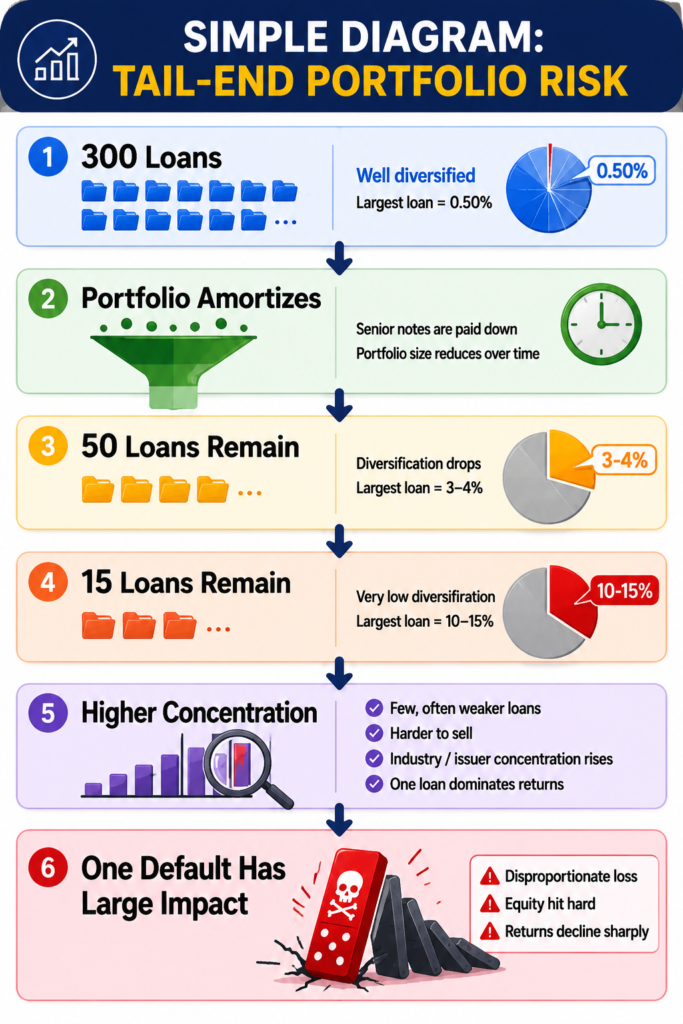
At CLO issuance:
Portfolio Size = 300 loans
Largest exposure = 0.50%
After several years:
Portfolio Size = 15 loans
Largest exposure = 12%
A single default now has a far greater impact than it would have had when the portfolio contained hundreds of loans.
This concentration effect is commonly referred to as Tail-End Risk.
Why Investors Care About CLO Tail Risk
Investors focus on CLO Tail Risk because losses often become magnified precisely when protection levels appear strongest.
Key concerns include:
For Equity Investors
- Reduced residual cash flows
- Increased volatility of distributions
- Potential erosion of equity value
For Debt Investors
- OC test failures
- Reduced credit enhancement
- Increased downgrade risk
For CLO Managers
- Reduced trading flexibility
- Higher concentration risk
- Difficulty disposing of weaker assets
Key Drivers of CLO Tail Risk
Credit Defaults
Higher-than-expected defaults can erode collateral value and reduce cash flow generation.
Recovery Rates
Lower recoveries increase realized losses and reduce protection for junior investors.
Portfolio Concentration
A smaller asset pool means each loan represents a larger percentage of the portfolio.
Market Liquidity
Tail assets are often difficult to sell without significant discounts.
Industry Exposure
Concentration in cyclical sectors can amplify losses during economic stress.
Key Metrics Used to Evaluate CLO Tail Risk
Break-Even Default Rate (BDR)
The maximum cumulative default level a tranche can absorb before suffering losses.
Scenario Default Rate (SDR)
Expected cumulative defaults under a specified rating stress scenario.
Diversity Score
Measures portfolio diversification. Lower diversification generally implies higher tail risk.
Overcollateralization (OC) Cushion
A larger OC cushion provides additional protection against collateral deterioration.
WARF
Weighted Average Rating Factor measures overall portfolio credit quality.
Concentration Tests
Monitor issuer, industry, and obligor concentrations.
Simple Diagram: Credit Stress Tail Risk
Simple Diagram: Tail-End Portfolio Risk
How CLO Managers Mitigate Tail Risk
Experienced managers attempt to reduce CLO Tail Risk through:
- Maintaining portfolio diversification
- Monitoring deteriorating credits early
- Actively trading weak positions
- Avoiding excessive industry concentrations
- Managing OC cushions carefully
- Reinvesting into stronger credits during the reinvestment period
Successful management of tail risk can materially improve long-term CLO performance.
Frequently Asked Questions (FAQ)
What is CLO Tail Risk?
CLO Tail Risk refers either to extreme low-probability credit stress events or to concentration risk that develops when only a small number of loans remain in a CLO portfolio.
Why is tail risk higher near the end of a CLO’s life?
As the portfolio shrinks, diversification declines and individual loan exposures become larger, making each default more impactful.
Who is most exposed to CLO Tail Risk?
CLO equity investors typically bear the greatest exposure, although severe scenarios can affect debt investors as well.
How do rating agencies analyze CLO Tail Risk?
They use stress scenarios involving default rates, recovery rates, SDRs, BDRs, and cash flow simulations.
Can CLO managers reduce Tail Risk?
Yes. Diversification, active trading, concentration management, and strong credit selection can significantly reduce tail risk exposure.
Conclusion
CLO Tail Risk is more than just the risk of an economic crisis. It also encompasses the practical challenges that arise as a CLO matures and the portfolio becomes smaller and more concentrated. While rating agencies focus on extreme credit stress scenarios, market practitioners often focus on tail-end portfolio risk. Understanding both perspectives provides a more complete view of how risks evolve throughout a CLO’s lifecycle and why active portfolio management remains critical long after a CLO is issued.